Research
My work moves between brain signals, machine learning, and tools that people can use. The projects differ, but each asks me to look closely at the distance between what a system appears to do and what it can actually support.
Here are some projects, with the questions behind them and the work I contributed.
Recognizing someone across sessions
A system can appear to recognize a person from their EEG and still struggle when the recording session changes. That gap became the starting point for my work on EEG biometrics.
I reproduced the problem using recordings from 83 subjects in the PhysioNet Motor Imagery dataset. Evaluating within a single session overstated accuracy by 25.96 points. The question was how to learn something about identity that would survive a change of session.
I proposed DA-EEGNet, a domain-adversarial version of EEGNet that uses gradient reversal to learn session-invariant identity representations. Under leave-one-session-out evaluation, it reached 85.11% accuracy. The SVM and EEGNet baselines reached 71.53% and 63.95%, respectively.
I also carried out a systematic cross-session channel ablation. Eight electrodes retained 80% of the performance of the full 64-channel setup, with a sharp decline below four. This let me ask a second, practical question: how much of the recording setup could we remove before the result changed substantially?
Taking individual differences seriously
At the Indian Institute of Science, I worked on attention-gated learning using EEG as a Research Science Institute scholar. I was one of 31 scholars selected nationally.
I examined how EEG varied from person to person even when the preprocessing was held the same. Those differences carried information. Treating them only as noise would have meant overlooking part of what the recordings could tell us.
I characterized that subject-level variability and presented the findings at a national neuroscience conference. The work kept my attention on the individual within a dataset: what a shared pipeline preserves, and what it can make easy to miss.
Making room for different ways of learning
With Project 2AS, I worked on EEG-based adaptive lesson plans for autistic children. The aim was to build learning tools informed by neuroscience and responsive to individual learners.
As AI team lead, I engineered personalized tools and helped grow a community of more than 4,000 parents around the platform. The work brought the technical system and the people using it into the same picture.
Working with what a camera can see
At Oculosense, I researched object-recognition pipelines for smart eyewear aimed at industrial safety applications. The work concerned how AI vision could be used in a wearable system.
I also contributed to assistive-technology projects for visually impaired users. Across these projects, the purpose of recognizing an object was tied to what that recognition could help a person do.
Giving an idea something to attach to
At the New York Academy of Sciences, I worked as a developer on an augmented-reality learning tool. It used physical objects to help students visualize scientific ideas.
I integrated object recognition into the system. The project was selected as a Finalist and International Runner-Up. It was one way of bringing an abstract lesson into the space a student could see around them.
Following food into everyday life
I started Nutrigene with a question about the relationship between food, gut health, and how we feel. I am exploring a nutrigenomics-based device for personalized dietary insights, alongside a possible community for people with similar health conditions. The work is still at the research and feasibility stage.
Making a game respond to attention
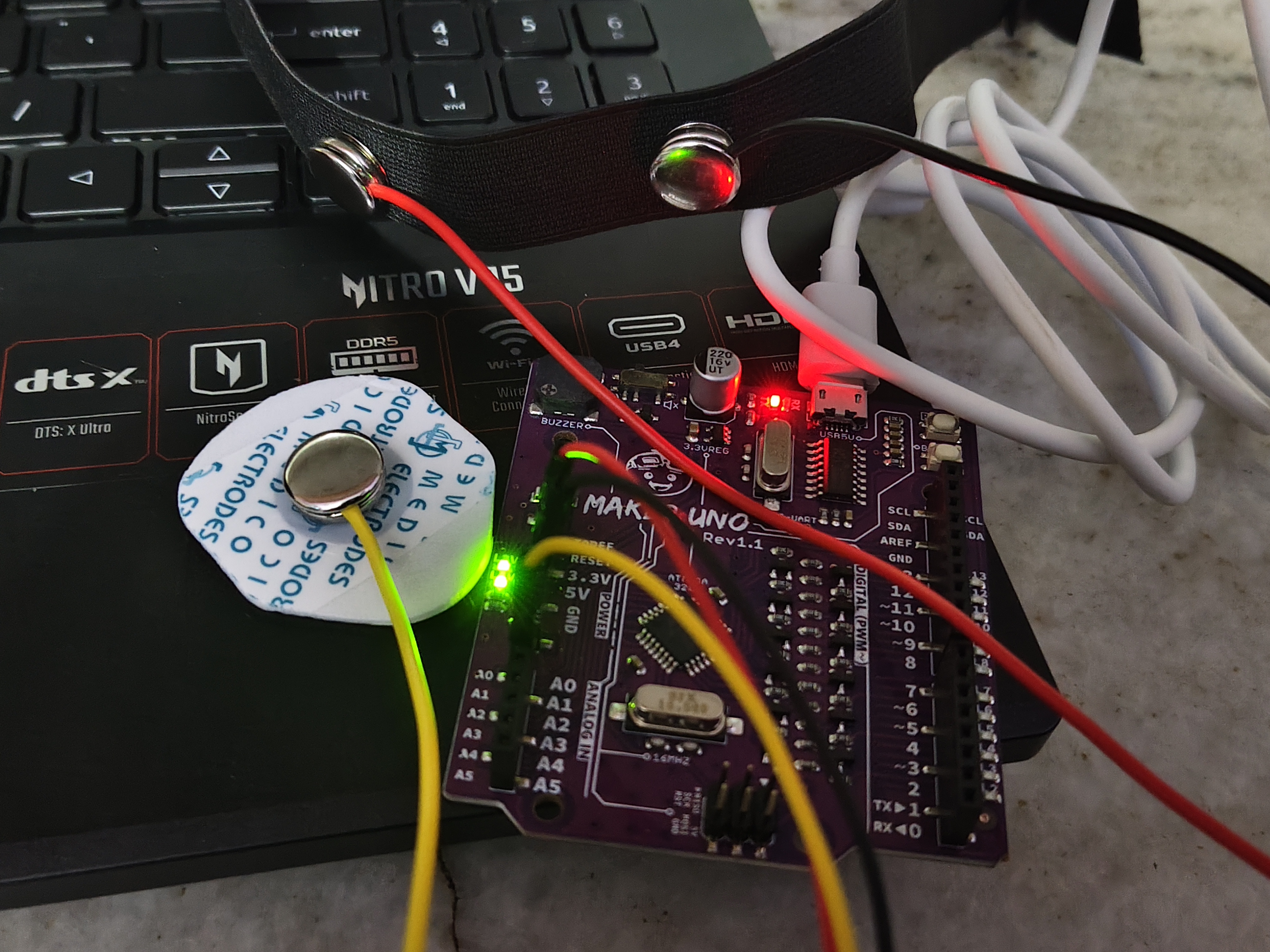
I built a simple EEG-controlled game to explore whether changes in concentration could become an input: focus made the character move faster, and relaxation slowed it down. Cleaning noisy brain signals was a central challenge in turning that idea into a working prototype.
Letting the surroundings become a lesson
With NeoLearn, I explored learning through objects and environments. Object recognition and AR overlays connected things in view to educational information, while VR offered spaces to explore concepts. I worked on responsive processing and collaborated with educators on the content.
Some of the questions continue in my writing. For roles and the rest of my work, there is a résumé.